
















Understanding the relationship between autism and ADHD can feel overwhelming, especially for adults who have gone undiagnosed or misdiagnosed for much of their lives. These neurodevelopmental conditions share some features but also differ in significant ways. This blog will outline the key differences, where they overlap, and when it might be helpful to consider a formal assessment. Whether you’re exploring these questions for yourself or someone you care about, this guide offers clarity and guidance grounded in evidence-based practice.
Understanding Core Differences
Though ADHD (Attention-Deficit/Hyperactivity Disorder) and autism (Autism Spectrum Disorder or ASD) are frequently discussed together, they are clinically distinct conditions. Each has unique features that affect attention, communication, behaviour, and sensory processing.
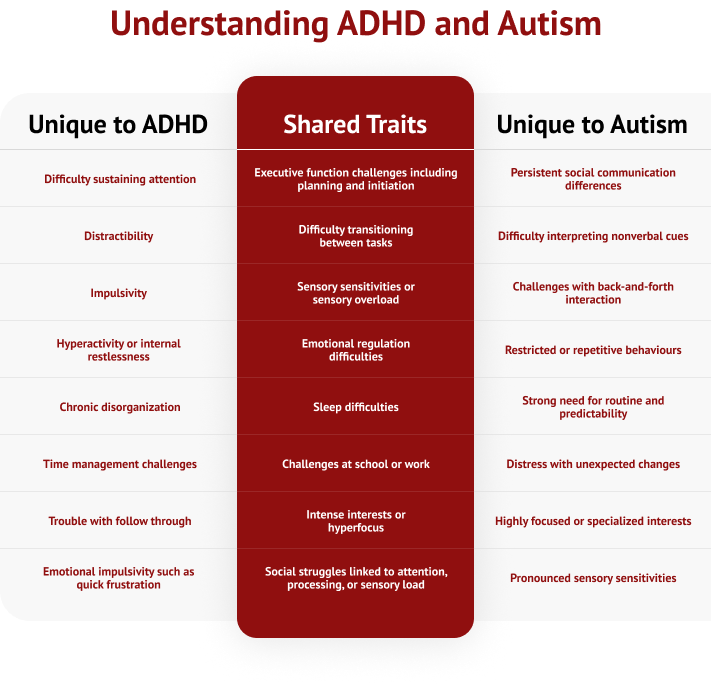
Autism is defined by persistent differences in social interaction and communication, as well as restricted or repetitive behaviours. This can include difficulty interpreting non-verbal social cues, a preference for routine, or highly focused interests. People on the spectrum may experience heightened sensory sensitivity, such as discomfort with certain textures, sounds, or lighting.
ADHD on the other hand, is typically characterized by difficulty with sustained attention, impulse control, and in some cases, hyperactivity. People with ADHD may appear easily distracted, forgetful, or restless. For adults, this often manifests as challenges with organization, time management, or follow-through with daily tasks. Emotional dysregulation, such as mood swings or low frustration tolerance, is common in adults with ADHD.
While both ADHD and autism affect executive function, the underlying causes and expressions of these challenges differ. A study published in ScienceDirect explains that individuals with autism tend to have more pronounced differences in social cognition, while those with ADHD often show broader attention-related difficulties without the same degree of social processing differences.
It’s important to remember that neither ADHD nor autism is a deficit or disorder in the traditional sense. These are simply different ways of experiencing and engaging with the world. Assessment and support are not about “fixing” but about understanding needs and strengths, empowering parents and caregivers to feel hopeful about tailored support options.
When the Conditions Overlap
The overlap between ADHD and autism is more common than many people realize. According to research published by the National Institutes of Health, as many as 50 to 70% of individuals with autism also meet diagnostic criteria for ADHD. This co-occurrence, often referred to as a dual diagnosis, can make it harder to identify which traits are linked to which condition. For example, both ADHD and autism can involve:
- Difficulty with transitions or shifting focus between tasks
- Sensory sensitivities or overstimulation in busy environments
- Struggles with emotional regulation
- Sleep difficulties
- Challenges in school, work, or social settings
While the outward behaviours may appear similar, the underlying causes are often different. Someone with ADHD may seem disorganized due to difficulties with attention, while an autistic person may struggle with organization as a response to anxiety or sensory overload.
AuDHD Psychiatry points out that this overlap can result in misdiagnoses or delayed identification, particularly among adults and individuals assigned female at birth. Many have adapted or masked traits to fit into social or workplace settings, which further complicates the diagnostic picture. Dr. Vicki Nolan, Psychology lead at The Redpath Centre notes: “In clinical practice we often see individuals who have been previously diagnosed with ADHD, either in childhood or adulthood, who then wonder if they are also autistic, given the extent of their social struggles.” Increasingly The Redpath Centre is seeing both autism and ADHD in adults who have never received either diagnosis: “We are seeing more co-occurring autism and ADHD clinically now as we understand the full breadth of the autism spectrum” says Dr. Nolan.
When to Seek an Assessment
Many people begin to question whether they might be neurodivergent after years of challenges that don’t seem to fit any single explanation. For adults especially, it’s common to reach this realization later in life—often after a child receives a diagnosis or following burnout or life transitions. You might consider seeking an assessment if you:
- Consistently struggle with focus, memory, or task initiation
- Feel drained by social interactions or unsure of how to navigate them.
- Are sensitive to lights, sounds, or textures
- Find routines helpful, but experience stress when they are disrupted.
- Feel like you’re constantly masking or performing to “fit in.”
Adults with ADHD or autism are sometimes misdiagnosed with anxiety, depression, or personality disorders. While these conditions can co-occur, it’s essential to identify the underlying neurotype to tailor support accordingly.
At The Redpath Centre, psychological assessments are designed to provide meaningful insights into attention, executive function, social communication, and sensory processing. These assessments help clarify whether an individual meets the criteria for ADHD, autism, both, or neither—and we do so within a respectful, neuro-affirming framework, fostering trust and reassurance in your path to understanding.