




















Noticing the possible early signs of autism in preschoolers can feel overwhelming and confusing–and at times when parents raise their concerns with family members, friends or even professionals, their worries are dismissed.
In this blog, we’ll guide you through what early signs might look like, how these differ from typical toddler behaviour, why early screening matters, and what to do if you have concerns. Every child grows at a different pace, and early support can help families feel more prepared and empowered.
Dr. Thomas Rhee, Child Psychologist at The Redpath Centre in Toronto has helped may families in the early stages of recognizing their child’s developmental pathways may be delayed or different. He strongly advocates for early identification and assessment: “Over the last 20 years, I’ve discussed with many families the benefits of early diagnosis. These include the opportunity for early intervention, which has shown to improve developmental outcomes, as well as access to appropriate supports.”
Early Signs
Autism, or autism spectrum disorder (ASD), affects how children engage socially, communicate, and respond to their environment. These differences can be noticeable in the toddler years, often between 18 months and 3 years. Common early traits may include:
- Delays in speech and language development or absence of speech;
- Limited response to their name or minimal eye contact;
- Repetitive movements and behaviours;
- Strong sensitivity to sounds, lights, or tastes or textures;
- Limited interest in interacting with peers or caregivers; and
- Intense focus on specific objects or routines.
It’s essential to note that the presence of one or more of these signs does not necessarily mean a child is autistic. Every child develops on their own timeline, and many behaviours may be related to other developmental factors or conditions. What matters most is paying attention to patterns over time. If behaviours seem consistent, unusual for the child’s age, or begin to interfere with daily life, it may be time to consider a developmental screening.
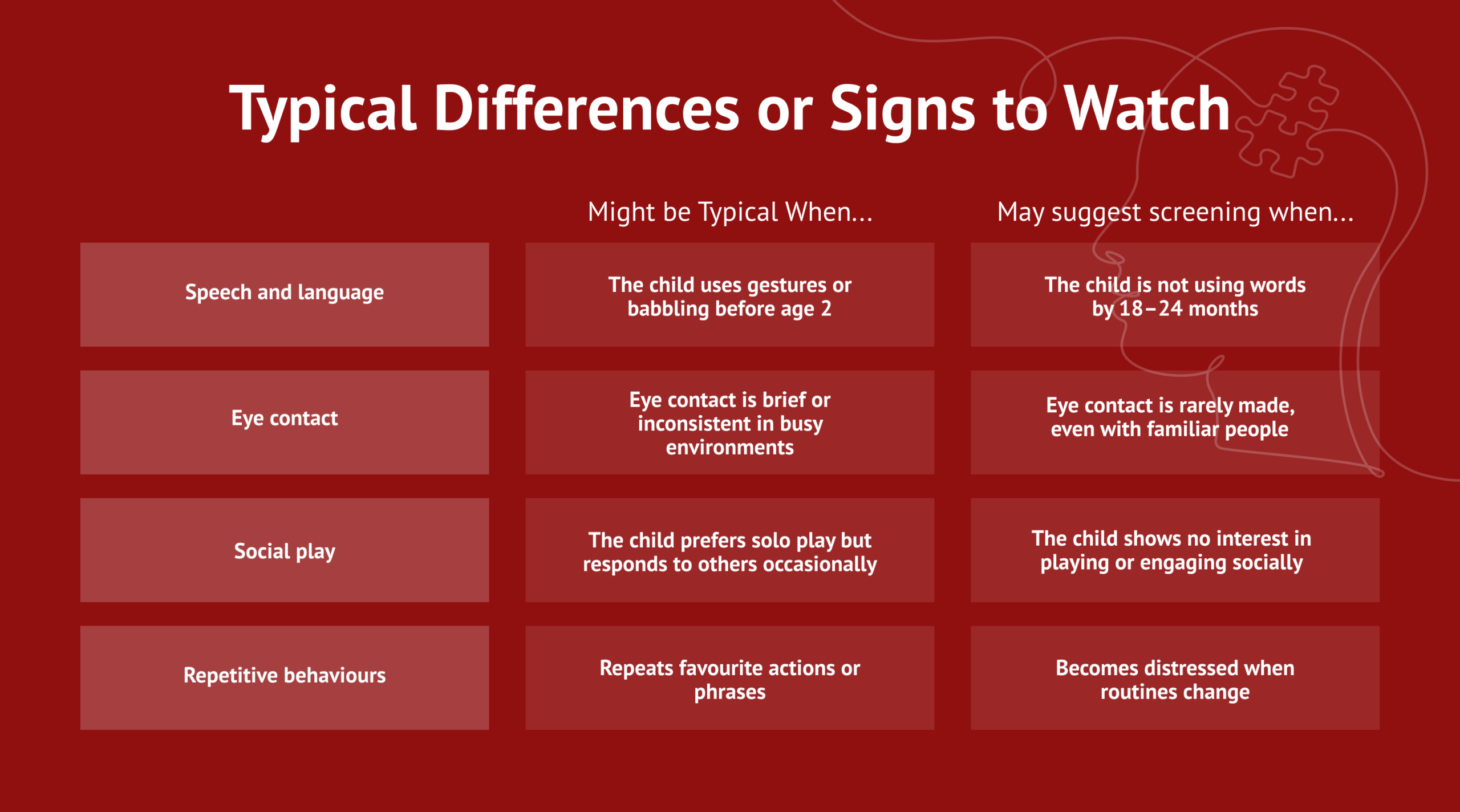
Preschoolers develop at different paces. Some talk early, while others take longer to say their first words. Some toddlers love group play, while others prefer more independent activities. So how do you tell the difference between a child’s natural preferences and signs of something that may need extra support? Here are some examples:
Early Screening
Early screening is a tool to identify whether a child may benefit from further assessment. It enables families and care providers to gain a deeper understanding of how a child perceives the world, supporting more informed decisions about early intervention. Screening typically involves:
- Observing how a child communicates and interacts
- Asking caregivers about developmental milestones
- Using tools designed to highlight differences in social, language, or motor skills
While a formal diagnosis is made through a comprehensive evaluation, early screening can be the first step toward tailored support. In many cases, this support focuses on modifying the environment to better meet their needs.
Screening is vital because early developmental years are a critical time for learning and growth. Early identification and support can improve outcomes in communication, play skills, emotional regulation, and social development.